Search

my marketing soapbox

My 3 fav tools for marketing

There are an infinite number of tools out there today to help a marketer out. Here are my favs at the moment.

1. canva.com

Cost: free (pay for certain elements)

My love for canva.com might be excessive. I’m not a graphic designer and starting from scratch in a program like Photoshop is difficult for my skill level. I’m proficient with PowerPoint but find when I’ve tried to use it as a design tool (ghastly, I know) the end result looks a bit Microsoft-y. Canva is the bridge for me.

Simply put, it’s an online tool to do design work. What’s magical about it is the pre-built templates stock images for everything from slide decks to Instagram posts. My output looks above average for a non-designer and it’s incredibly easy to use.  It’s a free tool. You just pay for images and some templates. There are a TON of free ones but those you do pay for usually cost $1. The downside is that only gets you 24 hours of access. Another downside is I’m not able to copy and paste from past projects nor set up branded color schemes that auto apply. Still, the amazing far outweighs the negatives. I use it weekly, sometimes daily.

2. Instapage.com

Cost: free to $179/mth

A common theme to this post is that I’m not a designer so I need tools to help me look like one. Instapage is a landing page building and hosting product. Instapage has really been a powerful tool that, again, is incredibly easy to use. I’ve built several landing pages by customizing their templates. What stands out to me is how easy it is to customize templates. I’ve used Pardot’s tool for this in the past and I would use Instapage over that any day. Of course the negative is everything else Pardot does (segmentation, tracking, CRM integration) is absent from Instapage. But it’s a great tool if you’re getting started and lack the budget for marketing automation.

Setting up our own url like go.WEBSITE.com so the page doesn’t look spammy was simple. Done once and applies to all of our landing pages.

Forms are intuitive and easy to customize. An added bonus is that I can push completed forms to Constant Contact (not my fav) which through Cazoomi is being synced with Microsoft Dynamics CRM. This is a cumbersome process, no doubt, but no reflection on Instapage – just what life looks like without a marketing automation solution.

3. slideshare.net

Cost: free

When I started with slideshare I thought it was just a tool where the cool kids were posting their presentation slides. But I’m a numbers girl and this has been a content distribution channel that has really paid off for me both in my personal brandingg and my 9-5 role.

I’ve posted a few different presentations and check daily, sometimes hourly, on the views.  The analytics and reporting show you views by day, social shares, downloads, email shares and more. Social sharing is very simple for the end-user which seems to encourage actual sharing. These insights are really powerful in understanding what content resonates with my audience.

If this is a channel you explore, I  recommend creating slides for slideshare explicitly. When I develop slides for a live presentation, I reduce text as much as possible. This doesn’t work in slideshare because there is no one speaking to the slides. The one exception… if you give a presentation and people who attended ask for your deck send it via slideshare instead of the file directly via email. This gives you (1) an opportunity show them more of your content (2) tracking on engagement of that deck.
Marketing Plan: Recommendations and Template

Need a marketing plan template?  Well I thought it might be helpful to share mine.

Marketing Plan Sample – Rebekah Gregg

And on that subject, here are a few key tips I’ve learned about creating a functional marketing plan that’s worth the amount of time it takes to make it create.

Go ahead and make one, and make it your own.

I’ve been amazed at how many marketers operate without a marketing plan… and I have been one of those marketers. Not having business objectives, not having a product roadmap, FILL IN THE BLANK – none of these are good enough excuses to not have a marketing plan. In fact, they are precisely the reason to have a marketing plan.

So quit making excuses or waiting until the next budgeting cycle or whatever your reason is. You need a marketing plan.

Make it your own. You’ll find templates online and your boss might even have one that she’d really like you to use. While it’s important to have consistency across a marketing team, don’t be afraid to add your personal stamp when it adds value. Marketing is a science that combines analytics with gut feel. My marketing plan has to tell a narrative, a story about the market and our place in it in a way that flows in my mind. Don’t be afraid to break a few rules to generate a plan that helps you do your job better.

The plan is for you first and foremost.

There was a time in my career when I was working with a group that was struggling in the midst of leadership changes. As is often the case, sales still had a quota and was putting demand on marketing for support. It felt like everything I did was never enough and I was constantly running around putting out fires.

I wallowed in fussiness for almost a year until finally I gave up hope. There would be no magnificent business plan for which I could whip up an equally fantastic marketing strategy. Yet if I never told the business owners what I planned to do, they could always add one more thing without removing something else I was already committed to deliver. The cycle of being busy but not being effective would continue.

From that realization, I put my head down and spent hours upon hours creating a marketing plan for the business. That process did a couple key things:

  1. It took all of the swirling thoughts about market pressures, the competitive environment and product positioning from my head and organized it. This caused me to think in a more organized fashion and deepened my knowledge.
  2. It demonstrated to my executive team that I understood our market positioning. This was a critical crossroad in gaining more of their respect and trust.

We’ve all sat in meetings where our already maxed out workload doubles with no new resources being added. A baked and shared marketing plan allows you to go to your decision maker and say, “I’m glad to do this new project, but here are the programs from the marketing plan you approved that will need to be cancelled/delayed/reduced. Is that what you’d like me to do?”

Don’t let the perfect be the enemy of the good.

I’m always looking to find the balance between being detailed enough to be valuable without being so detailed that the plan never gets done or is impossible to keep accurate. Unless you have a major milestone, it’s unlikely to be worth your time in November to decide what exact day in July of the following year you’re going to drop an email.  Keep it simple to start but be sure to go back and update, because…

The plan must be a living, breathing document.

You have to go back through the year and update the plan.  Cancel promotional campaigns that no longer make sense, adjust launch dates as needed, update tactical changes.  Also, I think the marketing plan is a great, one-stop place to capture your campaign results.  This in and of itself helps to keep the document accurate.

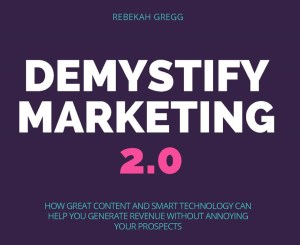
Demystifying marketing 2.0

In 2012 I returned to the discipline of marketing and felt as though my degree and prior experience were completely irrelevant. While I could look up the definition of terms like content marketing, drip campaigns, lead generation, and marketing automation I had no tangible experience with them. I felt old and incompetent.

Thankfully that all changed when I was asked to help stand up Pardot, a marketing automation tool. The work of that task forced me to roll up my sleeves and learn the nuances of this concept of marketing 2.0. I discovered the gut of what I am as a marketer was still relevant. Sensing needs and challenges and translating those cues into messaging and campaignsDymystify marketing 2.0 still applied. What changed was the approach and channels.

When I was a college student studying marketing circa 2005 companies that were able to send emails to their customers were on the leading edge. If those emails were pretty and you were able to automatically manage subscriptions you were knocking it out of the park. Today companies of all sizes are blasting their customers and prospects with emails on a daily basis. The game is no longer to stand up email marketing but rather to become an invited guest into your prospects’ inboxes so that your emails are not only delivered but read.

Take a few moments and check out my deck on SlideShare that helps to demystify this new approach to marketing.

For the love of marketing

soap boxI find myself a bit too often promising to get off my soapbox as soon as I make one last point about the evolution of marketing. There is a fine line between passionate and obnoxious and I’m fairly certain I cross it on a daily basis.

Despite my best efforts I just can’t help it and the reason why began almost three decades ago when I decided I wanted to buy and sell companies at the age of eight. I vividly remember pushing the clothes in my closet to the side as the space magically transformed into my office. I chose marketing as my career path in high school and never regretted it until two years ago.

After spending six years at a small healthcare provider doing very little marketing I found myself turning 30 and feeling as though I had lost touch. The bulk of my marketing experience was before I graduated college. I was concerned that if I didn’t return to traditional marketing my degree would become irrelevant and marketing doors would be closed for me.

I joined a large, healthcare IT company in the role of product marketing manager and was thrilled to finally experience corporate life. It took a year for the new job honeymoon to wear off until I began to experience complete frustration for the first time with this profession called marketing. Blasting customers repeated sales messaging felt inconsiderate and ineffective. I was unable to get excited about a 15% open rate and a 7% click through rate because let’s be real – that’s a 85% failure rate. To top it all off I had sales folks telling me my campaigns sucked yet demanding more of them.

That’s when I began down this path of discovering and learning exactly what marketing 2.0 is all about. Now that I not only understand it but have the opportunity to put it into practice, my passion for the profession of marketing has returned. There are several fantastic thought leaders in the space today who I’ve learned quite a bit from personally.  My unique perspective is from one in the weeds, doing the work and learning from trial and error. I hope to share this learning experience with you along the way and spread the love of a new way of marketing that builds a connection with the customer, balances sales messaging with education and ultimately generates leads.

Create a free website or blog at WordPress.com.

Up ↑